 Get in touch

OMCO Metals Slovenia invests in LPDC for bronze casting
Bronze neck rings may be small components, but their production requires a high level of control. They need consistent geometry, a strong surface finish and…
Bronze neck rings may be small components, but their production requires a high level of control. They need consistent geometry, a strong surface finish and reliable casting quality across series production. For OMCO Metals Slovenia, this calls for a process that combines foundry expertise with stable, repeatable production conditions. That is where LPDC comes in. At OMCO Metals Slovenia, Low Pressure Die Casting is used to produce bronze neck rings for OMCO Mould. The process gives the team a dedicated production route for these technically demanding components.
In this article, we take a closer look at how LPDC works, why copper moulds are used, and how pressure, cooling and engineering preparation come together in the process.

How LPDC works
The LPDC machine has a furnace below the mould that contains molten bronze. Low pressure pushes the metal upwards into the mould cavity. The mould fills in about 15 seconds. The pressure then drops. The part stays inside the mould for another 25 to 30 seconds so it can solidify further.
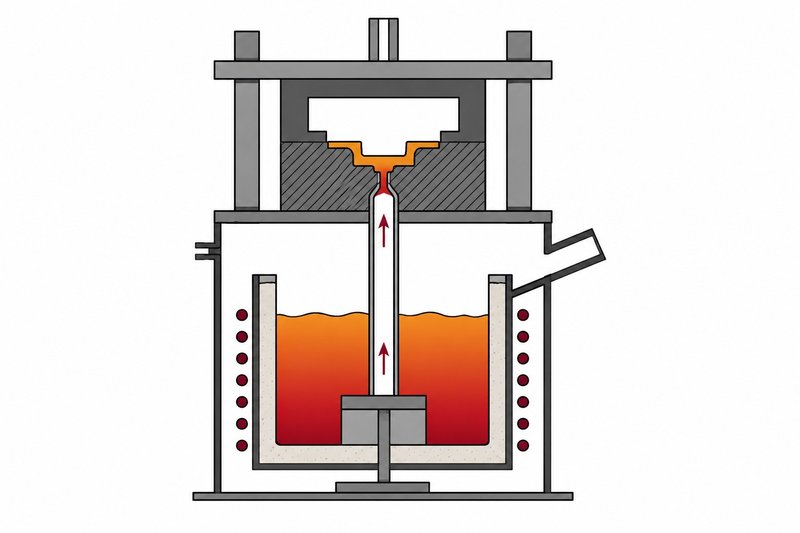
Next, the tool rotates and releases the part onto the discharge table. The mould then moves into a graphite bath. This cools and lubricates the tooling before the next cycle. The graphite also helps prevent the bronze from sticking to the mould. One complete cycle takes about 90 seconds.

Why copper moulds are used in LPDC
The LPDC tooling is made from an alloy containing approximately 98.5% copper. The reason is thermal conductivity. A significant amount of heat has to be extracted from the bronze quickly after filling. Copper transfers heat efficiently, which helps the part cool and solidify inside the mould.
Smaller components such as neck rings are well suited to this process because the heat can be removed quickly enough. Larger castings contain more thermal energy and require a different casting approach.
Engineering before production
LPDC does not remove the need for casting engineering. For every new product, the process starts with the component design. From there, flow and solidification simulations help our engineering team understand how the bronze will move through the mould and how the component will cool.
This information is used to determine the tooling concept and optimise the riser. Trial tooling is then produced and the first castings are evaluated internally. This includes checking the internal structure, porosity and machinability before the tooling is approved for serial production.
Risers remain part of the LPDC process because shrinkage still occurs during solidification. The objective is therefore to minimise the riser while ensuring it can still feed the casting correctly. This increases the proportion of usable material in each pour.
A controlled process for bronze neck rings
OMCO Metals Slovenia currently has four neck ring products running through the LPDC process. The technology is particularly suitable for smaller castings that can be cooled quickly enough inside the metal mould.
The current setup has been adapted specifically for the requirements of our bronze neck rings, including higher casting temperatures and increased cooling demand. This gives us a focused production capability for bronze neck rings within OMCO, combining reusable tooling, controlled filling and engineering expertise in one repeatable casting process.

Contact our team
Want to know more about OMCO Metals Slovenia and its bronze casting capabilities?
Contact our team to discuss your application or technical requirements.


What if the only thing left is the part itself?
Not every casting project starts with a complete drawing package. Sometimes, the only thing available is an existing component. No original CAD file. No technical…
Not every casting project starts with a complete drawing package. Sometimes, the only thing available is an existing component. No original CAD file. No technical documentation. No clear production history. Just the part itself. In those situations, the challenge is not only to reproduce the shape. The real challenge is to understand how that part was made, how it functions, and how it can be manufactured again in a reliable way. At OMCO Metals, this is where reverse engineering casting becomes relevant.

From existing part to digital model
The process starts by scanning the physical component. That scan creates a digital basis for further analysis, allowing the geometry to be examined in detail.
From there, the part is rebuilt into a usable 3D model. Critical dimensions can be restored, functional areas can be reviewed, and missing information can be reconstructed as accurately as possible. This step is essential because a scan alone is not enough. A foundry does not work from a raw scan file. The geometry has to be translated into something that can actually be cast, machined and controlled.
More than copying a shape
Reverse engineering casting is never just about replication. A component may have been designed years ago, produced with a different process, or used in conditions that caused wear and distortion over time. That means the existing part does not always represent the ideal production geometry anymore.
This is why the process also involves engineering judgement. The part has to be evaluated as a casting again. How will the metal flow? Where could shrinkage occur? Which surfaces need machining afterwards? Which dimensions are critical for fit and function? Only after that evaluation can the geometry be translated into a manufacturable casting solution.
From 3D scan to tooling and production
Once the digital model has been prepared, the next step is not production immediately. First, the tooling has to be created. At OMCO Metals, the scanned and rebuilt geometry can be used as the basis for the tools needed to bring the part back into production. From there, the casting setup can be prepared and the final surfaces can be machined back to specification.
This is where OMCO Metals combines foundry knowledge with practical manufacturability. Recreating a part is not just a design exercise. It is about making sure the final component can perform again in real operating conditions.

What are the use cases?
Reverse engineering casting is especially relevant for:
- obsolete parts
- legacy equipment
- machines with missing documentation
- urgent replacement needs
- components for which the original supplier no longer exists
In all of these cases, continuity depends on more than simply having a worn sample on the table. It depends on having the technical capability to interpret that part correctly and turn it back into a reliable casting.
Making sure a good part can be made again
A well-designed component can remain in service for many years. But when documentation disappears, replacement becomes a challenge. That does not mean the part is lost. With the right combination of 3D scanning, engineering, tooling, casting and machining knowledge, an existing component can become the starting point for a new production route.
At OMCO Metals, reverse engineering casting helps make sure a part that still matters can still be made.
Do you have a need for this service? Contact us at sales@omcometals.com
