 Get in touch

Shaping sustainability in glass manufacturing
Discover how OMCO Metals is revolutionizing the glass mould industry with sustainable practices. By prioritizing reusability, repairability, and material recovery, we’re reducing waste and minimizing environmental impact. Join us in creating a more circular and eco-friendly future.
Glass is one of the most recyclable materials in the world, but the tools that shape it also play an essential role in building a sustainable future. At OMCO Metals, we create materials for the glass mould industry that are designed and managed with sustainability at their core. This ensures that valuable resources are preserved and reused for as long as possible.
Reusability and repairability
Our moulds are not single-use tools. Throughout their lifecycle, they are carefully maintained, reconditioned, and repaired. When moulds begin to wear down or show signs of damage, they are not immediately discarded. Instead, they undergo a meticulous reconditioning process that restores their functionality and extends their useful life. This reduces waste while ensuring consistent performance for our customers.
Material recovery
Even when glass moulds eventually reach the end of their lifecycle, they do not become waste. Instead, they are reintegrated into the production loop through material recovery. This involves:
- Collection: Used moulds are returned from our customers’ plants.
- Reformation: The valuable metals are melted down and reformed into new moulds or other products.
- Loop Continuity: This closed-loop approach reduces the need for new raw materials and minimizes environmental impact.
A circular approach to manufacturing
By combining reusability, repairability, and material recovery, OMCO ensures that the resources used in mould-making are continuously recycled. This approach not only strengthens the durability and efficiency of our products but also contributes to a more responsible and eco-friendly manufacturing process.
At OMCO, we believe in a future where product and process exist in harmony with the planet.


OMCO Metals receives supplier award from Accelleron for quality and delivery performance
At OMCO Metals, long-term partnerships are built on more than technical capability alone. They depend on consistency, reliability and the ability to deliver complex parts…
At OMCO Metals, long-term partnerships are built on more than technical capability alone. They depend on consistency, reliability and the ability to deliver complex parts on time, year after year.
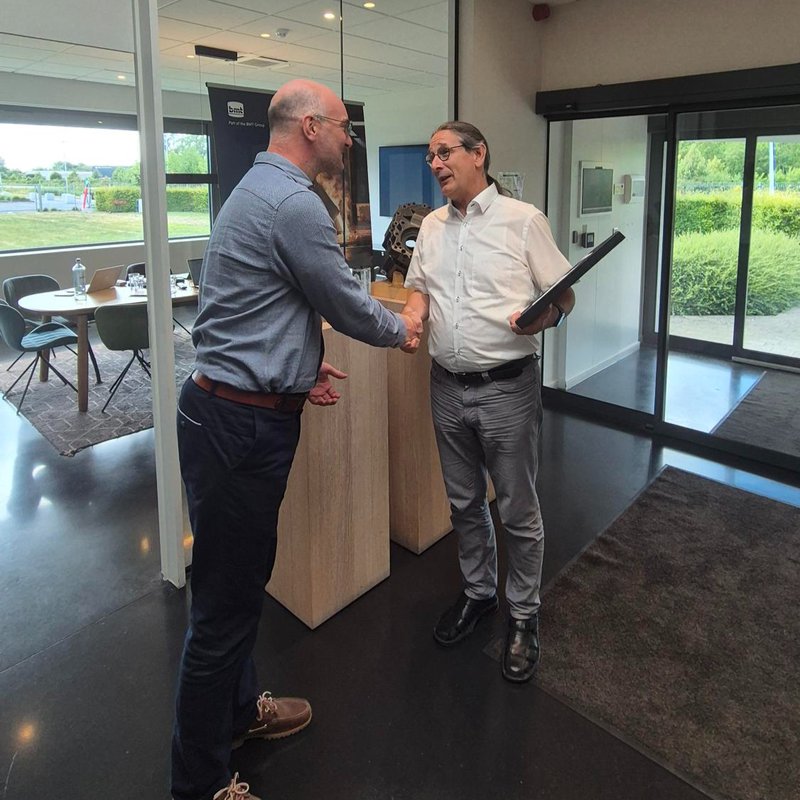
That is why we are proud to share that we have received a supplier award from Accelleron in recognition of our performance in 2025.
A two-day visit to Hamme
Recently, our Swiss customer Accelleron visited our site in Hamme for a two-day visit. A key part of that visit was a full audit of our operations, which was completed smoothly and closed with a positive result. The visit also created the opportunity to reflect on a partnership that has now been growing for more than 10 years.

Recognition for quality and delivery
The supplier award was granted in recognition of the way OMCO Metals delivers complex cast components, including machining, with a high level of reliability and punctuality. For customers operating in demanding environments, delivering the right part is essential, but delivering it consistently and on time is what builds trust over the long term.
The only supplier in Europe
What makes this recognition even more meaningful is that OMCO Metals received this award as the only supplier in Europe. For our team, this is a strong sign that the daily work behind every casting, every machining step and every delivery makes a real difference.
A result built by people
Awards like this are never the result of one moment. They reflect the combined effort of many people across engineering, production, machining, quality and logistics We would like to thank Accelleron for their trust and for the recognition of our work. And above all, we would like to thank our teams for the precision, commitment and reliability behind this achievement.
If you would like to learn more about OMCO Metals and how we support customers with complex cast components, feel free to contact us at sales@omcometals.com.
